'Stock market basics explained' sounds simple until you try to buy your first fund or read a stock quote. At its core, the stock market is a regulated marketplace where investors buy and sell ownership stakes in public companies. Those stakes are called shares. Prices move continuously as buyers and sellers react to earnings, interest rates, economic data, and expectations about the future. This guide covers the foundation: what the market is, how stock ownership works, the main ways to invest, how to place an order, and how to manage risk without chasing hype.
What the Stock Market Actually Is

The stock market is not a single building or a single price. It is a network of exchanges, broker-dealers, clearing systems, and regulators. In the United States, the two best-known stock exchanges are the New York Stock Exchange and Nasdaq. Companies list their shares on an exchange so investors can trade them in the secondary market. The primary market is where companies raise capital by selling new shares, such as in an initial public offering. After that, most trading happens between investors on the secondary market.
The SEC regulates securities markets and requires public companies to disclose material information. FINRA oversees broker-dealers and writes rules for member firms. The SIPC provides limited protection if a brokerage firm fails, up to $500,000 per customer including up to $250,000 for cash claims, but it does not protect against market losses. That distinction matters: custody protection is not investment insurance.
Indexes are statistical snapshots, not investable companies. The S&P 500 tracks about 500 large U.S. companies; the Dow Jones Industrial Average includes 30 large companies and is price-weighted; the Nasdaq Composite includes many companies listed on Nasdaq. Investors often use indexes to gauge market performance, but an index level is not a price you can buy directly.
Market prices are set by supply and demand at the exchange level. A market maker or exchange matching engine pairs buyers and sellers. The bid is the highest price a buyer will pay; the ask is the lowest price a seller will accept. The gap between them is the bid-ask spread, and it is one hidden cost of trading. Highly liquid stocks usually have tight spreads, meaning you can enter and exit with less price friction. Thinly traded stocks can have wide spreads and sudden price gaps.
How Owning a Stock Works
A share of common stock represents a residual ownership claim on a company. Residual means shareholders are paid after employees, suppliers, lenders, and bondholders. In exchange for that lower priority, shareholders can benefit from growth in earnings and share price, and some companies pay dividends. Common shareholders may also vote on director elections and other matters. Preferred stock sits between common stock and bonds in priority, often pays a fixed dividend, and usually has limited voting rights.
Total return has two parts: price change and dividends. If a stock rises from $50 to $55 and pays $1 in dividends, the total return is $6, or 12%, before taxes and fees. That math is simple; predicting the next year is not. Stock prices reflect expectations about future cash flows, discount rates, and risk. When interest rates rise, the present value of future profits tends to fall, which can pressure valuations. When earnings grow faster than expected, prices can rise. Sentiment and liquidity also move prices in the short run.
Market capitalization is share price multiplied by shares outstanding. It is a rough size measure: large-cap, mid-cap, and small-cap. Size does not tell you whether a stock is a good value. A large company can be overpriced, and a small company can be reasonably priced. Valuation ratios such as price-to-earnings help compare expectations, but they are tools for context, not buy or sell signals.
Investors should also understand dilution. Companies can issue new shares to raise money or compensate employees, which reduces each existing shareholder's percentage ownership. Buybacks can reduce share count, but they are not automatically good; the price paid matters. Dividends are not free money either. On the ex-dividend date, the share price typically adjusts downward by roughly the dividend amount, though taxes and market moves complicate the picture.
The Main Ways to Invest in the Market
There are several routes into the stock market, and each has trade-offs.
- Individual stocks: You choose specific companies. This offers control and transparency but requires research and can create concentration risk. A single company can fall sharply or go to zero.
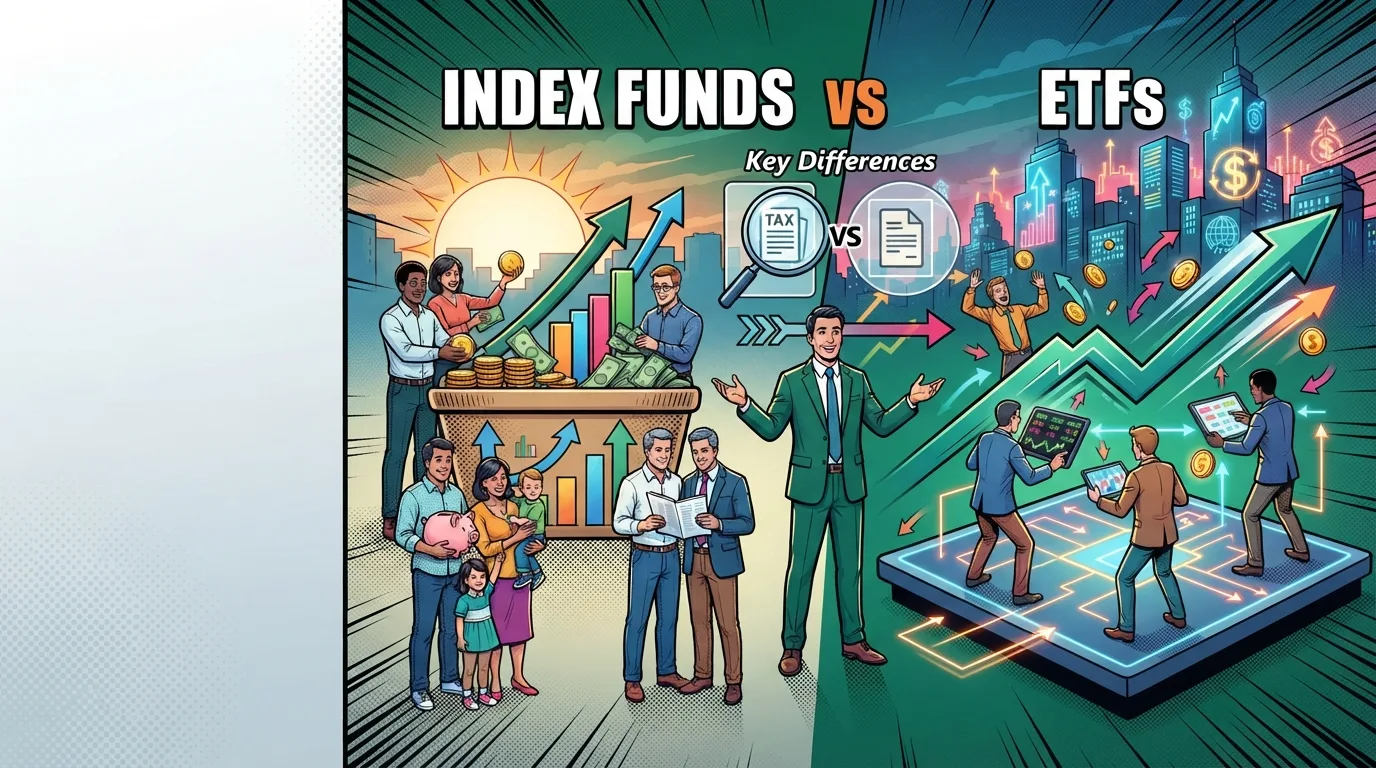
- Index funds and ETFs: These pools hold many securities and aim to track an index. Broad index funds offer instant diversification and usually low costs. ETFs trade during the day like stocks; traditional mutual funds trade at the end-of-day net asset value.
- Actively managed funds: A manager selects securities with the goal of beating a benchmark. Fees are typically higher, and outperformance is not guaranteed. Compare expense ratios, turnover, and tax efficiency.
- Target-date funds: Common in retirement plans, these automatically shift from more stock exposure to more bond exposure as the target date approaches. They are a simple all-in-one option, but the glide path and fees vary.
- Dividend-focused strategies: These emphasize income, but a high dividend yield can signal risk. A company can cut its dividend. Yield is not the same as total return.
For most beginners, a low-cost, broadly diversified index fund inside a tax-advantaged account is a reasonable starting point, but suitability depends on goals, time horizon, tax situation, and risk tolerance. An emergency fund and any high-interest debt usually deserve attention before investing. Money needed within a few years is generally a poor fit for stock-heavy portfolios because a market decline could arrive just when you need to withdraw.
How to Place a Trade and Build a Portfolio
Opening a brokerage account requires identity verification and, in many cases, a bank link. Retirement accounts such as 401(k)s and IRAs have annual contribution limits set by the IRS; those limits change, so check current rules. A taxable brokerage account offers flexibility but no upfront tax deduction. Tax-advantaged accounts may impose penalties for early withdrawals, so match the account to the goal.
Order types matter:
- Market order: Buys or sells at the next available price. It prioritizes execution over price. If a stock is quoted at $49.95 bid and $50.05 ask, a market buy will likely fill near $50.05.
- Limit order: Sets the maximum you will pay or the minimum you will accept. It prioritizes price over certainty of execution. A limit buy at $49.90 may not fill if the stock never trades down to that level.
- Stop order: Becomes a market order when a trigger price is reached. In fast markets, the execution price can be far from the trigger.
- Fractional shares: Some brokers allow purchases of less than one share. Availability and rules vary.
A simple portfolio construction process is to define the goal, set the stock-bond mix, diversify within each asset class, keep costs low, and rebalance periodically. Rebalancing means selling some of what has grown and buying what has lagged to return to target weights. It is a risk-control exercise, not a prediction.
Dollar-cost averaging, or investing a fixed amount on a schedule, can reduce the risk of investing a lump sum at a bad moment. It does not eliminate risk, and lump-sum investing has historically outperformed in many markets because prices have risen over time. The right choice depends on cash flow and comfort with volatility.
Understanding Risk, Volatility, and Time Horizon
Risk is not just price movement. It includes the chance of permanent loss, inflation eroding purchasing power, concentration in one company or sector, liquidity risk, and the risk of selling at the wrong time. Volatility is the size and speed of price swings. A volatile investment can be appropriate for a long horizon and inappropriate for money you need next year.
History is useful context, not a forecast. From 1928 through 2023, U.S. large-company stocks averaged roughly 10% per year before inflation, according to NYU Stern data, but the range of annual returns was wide. The S&P 500 fell about 57% from its 2007 peak to its 2009 trough and dropped roughly 34% in about a month during the 2020 pandemic shock. Investors who sold near those lows locked in losses; investors who held a diversified plan and rebalanced had a different experience. Past performance does not guarantee future results.
Time horizon is a key input. Money needed within a few years generally belongs in cash-like or short-term fixed-income investments, not stocks. Longer-term goals can tolerate more stock exposure because there is more time to recover from drawdowns. Asset allocation, the mix of stocks, bonds, and cash, explains much of a portfolio's risk and return over time. A portfolio that is 90% stocks may be reasonable for a 30-year retirement goal and unreasonable for a home down payment next year.
Common Beginner Mistakes to Avoid
- Investing without an emergency fund. Selling investments during a job loss can turn a temporary market decline into a permanent loss.
- Chasing recent winners. Strong past returns can reflect crowded expectations. Diversification is cheaper than prediction.
- Ignoring fees and taxes. Expense ratios, trading costs, and taxes compound against you. A low-cost fund in a tax-advantaged account can be more efficient than a high-cost product.
- Trading on headlines. News is quickly priced in. Frequent trading can add costs and mistakes without improving results.
- Checking prices too often. Daily noise can encourage emotional decisions. Match monitoring to your plan.
- Using leverage or options before understanding them. Borrowed money and derivatives can magnify losses. They are not basic building blocks for most new investors.
A written investment policy statement helps. It can state the goal, time horizon, target allocation, rebalancing rules, and what would cause a change. It also creates a record so you can judge decisions by process, not by short-term outcomes. If you work with an adviser, ask how they are paid and whether they act as a fiduciary. Those details affect the advice you receive.
Bottom Line
Stock market basics explained in one sentence: you buy shares of businesses through regulated markets, earn returns from price changes and dividends over time, and manage risk through diversification, low costs, and a suitable time horizon. No investment is guaranteed, and prices can fall sharply. Start with an emergency fund, choose an account that matches your goal, use broad diversification, keep fees low, and write down a plan before the next headline tests your resolve.