Investing in stocks can feel intimidating if you are starting from scratch. The headlines move fast, the jargon is dense, and plenty of people online promise easy money. A better approach is to treat stock investing as a long-term process: build a financial cushion, understand the risks, choose a sensible account and broker, and buy diversified investments rather than chasing individual companies. This guide explains how to invest in stocks for beginners in practical steps, with an emphasis on controlling costs and avoiding decisions that are hard to undo.
1. Build Your Financial Foundation Before You Invest

Before you buy a single share, make sure your household finances can handle volatility. Stocks can fall sharply and stay down for years, so money you need soon generally does not belong in the stock market.
- Build an emergency fund. Many planners suggest keeping three to six months of essential expenses in a savings account or other low-risk account. The right amount depends on your job stability, income variability, and family obligations.
- Pay down high-interest debt. Credit card balances and similar debt often cost far more than a diversified stock portfolio is likely to earn over time. Reducing that debt is often the higher-return move.
- Match investments to your time horizon. If you need the money within a few years, a savings account, certificate of deposit, or short-term bond fund may be more appropriate than stocks.
- Write down your goal. Retirement, a home down payment, and a child's education have different time frames and risk tolerances. A clear goal helps you choose the right account and investment mix.
This step is not glamorous, but it prevents a common beginner mistake: selling stocks at a loss because an unexpected expense forces you to raise cash at the wrong time.
2. Understand What Stocks Are and the Risks You Accept
A stock represents partial ownership in a company. Investors can earn returns through price appreciation and, for some companies, dividends. But ownership also means accepting risk. Individual companies can struggle, industries can decline, and broad market indexes can fall significantly in a recession or financial crisis. According to the SEC's Investor.gov, stocks are securities that represent ownership in a corporation, and their prices can rise or fall based on company performance and market conditions.
Beginners should understand several kinds of risk:
- Company-specific risk. A single company can lose value because of poor management, competition, lawsuits, or accounting problems. Diversification reduces this risk, though it does not eliminate it.
- Market risk. Broad stock indexes can decline when investors become pessimistic about the economy, interest rates, or global events.
- Behavioral risk. Fear and excitement can lead to selling after declines or buying after rallies. A written plan helps counter emotional decisions.
- Inflation risk. Keeping all your long-term money in cash can erode purchasing power over time, even if the balance feels stable.
Past performance does not predict future results. Historical stock market returns are useful context, not a promise. A reasonable goal is to earn a fair return over decades while keeping risk at a level you can tolerate.
3. Choose the Right Account and Brokerage
Your account type affects taxes and withdrawal rules, so choose it before you focus on specific investments.
- Taxable brokerage account. You can invest after-tax money and withdraw it without retirement-account penalties. Taxes on dividends and realized gains apply. This account is flexible but less tax-advantaged.
- Workplace retirement plan. If your employer offers a 401(k), 403(b), or similar plan, consider contributing at least enough to earn any employer match. The match is part of your compensation, but review the plan's fees and fund choices.
- Individual retirement account. Traditional and Roth IRAs offer tax advantages, subject to IRS eligibility and contribution limits. Rules differ, so check current IRS guidance.
When comparing brokers, look beyond flashy apps. Check commissions and fees, account minimums, fund expense ratios, available investments, customer service, and security practices. Confirm that the broker is registered with the SEC and is a member of FINRA. You can check disciplinary history through FINRA's BrokerCheck. Also understand that SIPC protection covers certain missing assets if a brokerage firm fails, within limits; it does not protect you from market losses.
4. Start With Broad, Low-Cost Diversified Funds
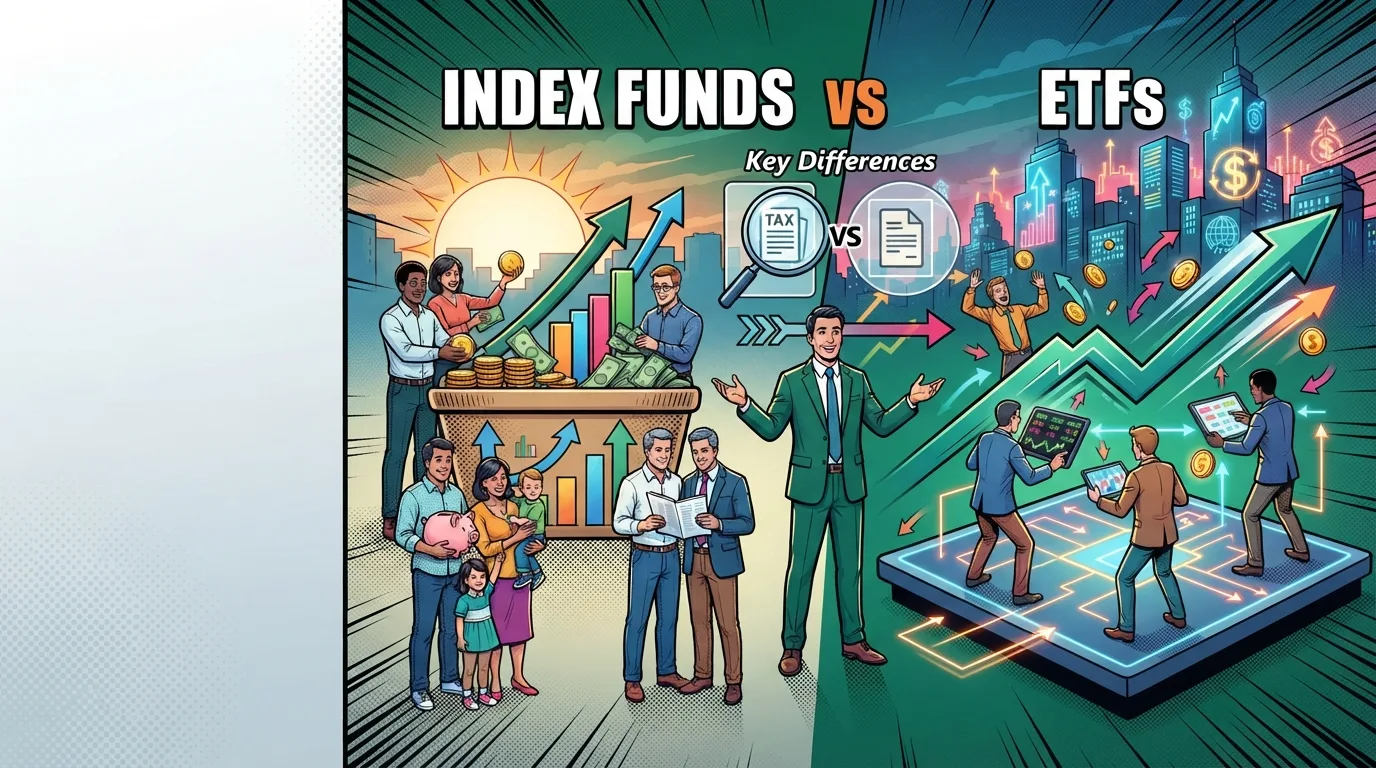
For most beginners, the simplest stock market approach is a broad, low-cost index fund or exchange-traded fund. These funds hold many companies in one investment, which reduces the impact of any single company's problems. They also tend to have lower expense ratios than actively managed funds.
Consider these categories:
- Total U.S. stock market index fund. Holds large, mid-size, and small U.S. companies.
- S&P 500 index fund. Tracks 500 large U.S. companies. It is diversified across large companies but concentrated in the largest names.
- Total international stock index fund. Adds exposure to developed and emerging markets outside the United States.
- Target-date fund. Automatically adjusts its mix over time and may be useful in a retirement account, though fees and glide paths vary.
These are categories, not personal recommendations. Read the fund's prospectus and summary to understand holdings, fees, and risks. Keep an eye on the expense ratio: a difference of one percentage point per year can meaningfully reduce long-term returns. Research from S&P Dow Jones Indices' SPIVA reports has consistently found that most actively managed U.S. equity funds underperform the S&P 500 over long periods, which is one reason low-cost index funds are popular with long-term investors.
Individual stocks can be part of a portfolio, but beginners should generally limit them to a small portion of total investments and only after building a diversified core.
5. Decide How Much to Invest and Automate the Process
Only invest money you will not need for several years. A common rule of thumb is at least five years for stock money, but your own situation may call for a longer horizon. If you are saving for a goal that is close, prioritize stability over potential growth.
Once you have an emergency fund and a manageable debt load, choose an amount you can invest consistently. Automating contributions helps remove emotion from the process. Many brokers allow automatic transfers and purchases, and some support fractional shares, which lets you invest a fixed dollar amount rather than buying a whole share.
Dollar-cost averaging means investing a fixed amount on a regular schedule, such as monthly. It can reduce the risk of investing a large sum right before a market drop, and it builds a habit. It does not guarantee better returns than investing a lump sum, and research has generally favored lump-sum investing when money is already available. For beginners, the bigger advantage of dollar-cost averaging is behavioral: it makes investing routine and easier to continue during volatile periods.
6. Place Orders Correctly
Understanding order types can prevent costly mistakes. A market order buys or sells at the next available price, which may differ from the price you saw a moment earlier. A limit order sets the maximum price you will pay or the minimum price you will accept. Limit orders can protect you from sudden price swings, but they may not execute.
Other practical points:
- Check the bid-ask spread, especially for less heavily traded investments. A wide spread is an implicit cost.
- Avoid rushing orders in the first or last few minutes of the trading day, when prices can be more volatile.
- Reinvest dividends only if it fits your plan and tax situation. Reinvestment can simplify compounding but creates tax records in taxable accounts.
- Keep trade confirmations and account statements for your records.
7. Rebalance and Review Your Portfolio Regularly
Rebalancing means returning your portfolio to your target mix after market movements change it. If stocks have done well, they may now be a larger share of your portfolio than you intended. Selling some stocks and buying bonds, or directing new contributions toward the underweight asset, brings the portfolio back to its target risk level.
Many investors review once a year or when allocations drift by a set amount, such as five percentage points. Rebalancing is not about predicting the market; it is about controlling risk. In taxable accounts, consider the tax impact of selling appreciated investments. In retirement accounts, rebalancing generally does not trigger current taxes.
8. Avoid Common Beginner Mistakes
- Chasing hot stocks or themes. By the time an investment is widely discussed, much of the optimism may already be priced in.
- Trying to time the market. Missing a few strong days can hurt long-term returns, and no one consistently knows when those days will occur.
- Ignoring fees. Fund expense ratios, advisory fees, and trading costs compound over time.
- Concentrating too heavily. A portfolio built around one employer or one stock carries unnecessary risk.
- Using leverage or complex options too early. These tools can amplify losses and are not suitable for most beginners.
- Selling during a downturn without a plan. A diversified portfolio and a suitable time horizon make it easier to stay invested.
Bottom Line
Learning how to invest in stocks for beginners is mostly about discipline, not clever stock picking. Build an emergency fund, reduce high-interest debt, choose the right account, and start with broad, low-cost diversified funds. Automate contributions, use sensible order types, rebalance periodically, and keep fees low. Stock investing involves real risk and returns are not guaranteed, but a simple long-term plan can help you participate in the market without taking unnecessary chances.