
Index funds vs ETFs is a common search, but the comparison is often framed too narrowly. An index fund is an investment strategy: a fund designed to track a market index, such as the S&P 500 or the CRSP US Total Market Index, rather than rely on a manager's stock picks. An ETF, or exchange-traded fund, is a fund structure that trades on an exchange. Many ETFs are index funds, and many index funds are mutual funds. The practical decision is usually between an index mutual fund and an index ETF. Both can offer broad diversification and low costs; the differences are in trading, pricing, taxes, minimums, and automation.
The Core Difference: Structure, Not Strategy
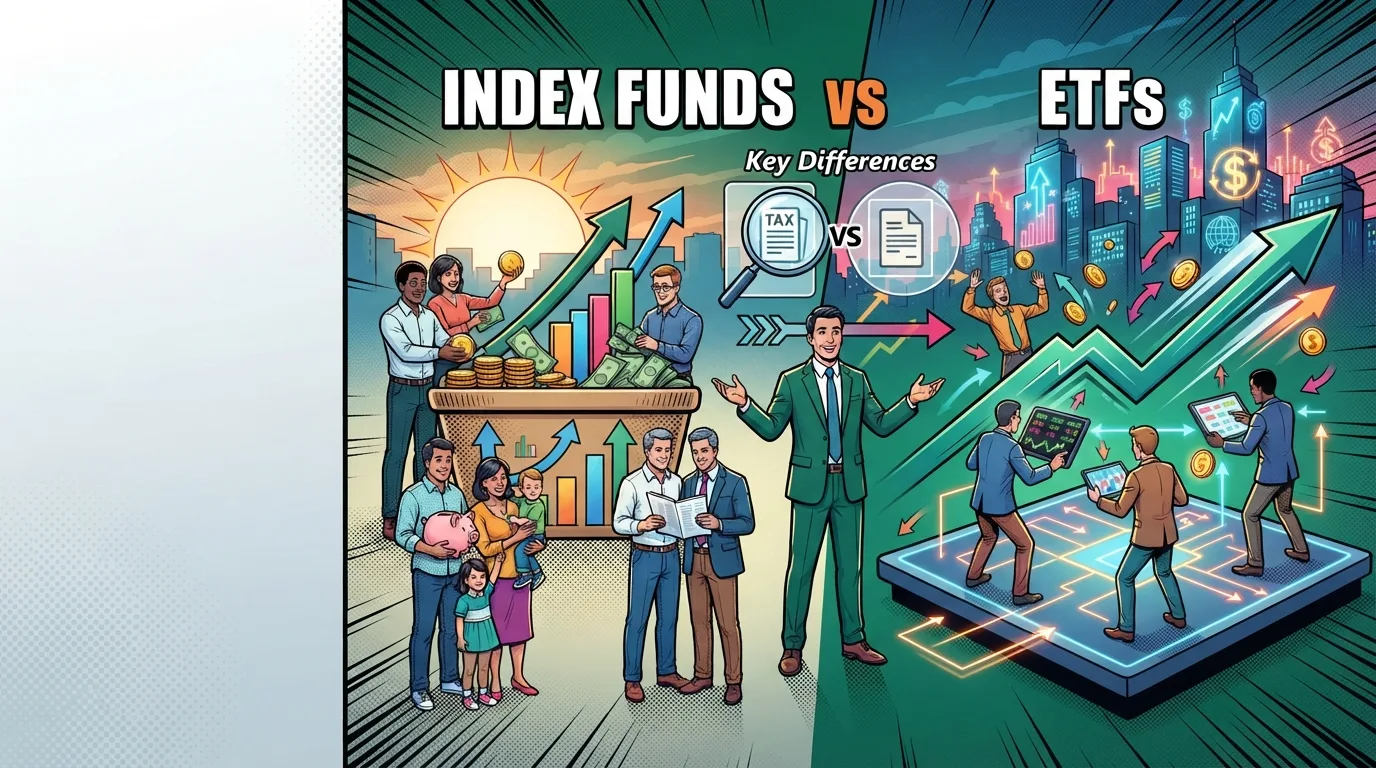
An index mutual fund and an index ETF can hold the same securities and track the same benchmark. The biggest difference is how you buy and sell.
- Mutual fund: You place an order with the fund company or broker. The fund calculates its net asset value (NAV) once per trading day, after the market closes. All investors who buy or sell that day generally get the same NAV, subject to any sales charges or redemption fees.
- ETF: You buy and sell shares on an exchange during market hours. The price moves throughout the day based on supply and demand. You can use market orders, limit orders, and stop orders, though limit orders are generally safer for ETFs because they control the price you pay.
- Creation and redemption: ETF shares are created and redeemed in large blocks by authorized participants, typically market makers. Mutual fund shares are issued and redeemed by the fund itself.
- Strategy vs. wrapper: An ETF can be index-based or actively managed. An index fund can be a mutual fund or an ETF. So index fund vs. ETF is not always an either-or choice; it is often index mutual fund vs. index ETF.
A useful example is Vanguard Total Stock Market Index Fund. Its Admiral Shares (VTSAX) are a mutual fund, and its ETF Shares (VTI) are an ETF share class of the same fund. Both track the same broad U.S. stock market index. Most fund families do not offer both structures for the same strategy, so investors usually choose one or the other.
Costs: Expense Ratios, Spreads, and Minimums
Costs matter, but the headline expense ratio is not the only cost.
- Expense ratio: This is the annual fee deducted from fund assets. Broad index ETFs and index mutual funds often have low expense ratios, sometimes in the low single-digit basis points. But neither structure is universally cheaper. A small ETF can be more expensive than a large index mutual fund, and a mutual fund may offer lower-cost institutional shares in a retirement plan.
- Trading costs: ETFs trade like stocks, so you may pay a bid-ask spread, a commission if your broker charges one, and a premium or discount to NAV. Many major brokers now offer commission-free ETF trades, but spreads still exist. Mutual funds do not have an intraday spread; you get the NAV, though some brokers charge a transaction fee or the fund may have a short-term redemption fee.
- Minimums: Mutual funds often require a minimum initial investment, such as $1,000 or $3,000, though many index funds now have lower minimums. ETFs are bought by the share, so the minimum is the share price, and many brokers allow fractional shares.
- Automation: Mutual funds commonly support automatic investment and automatic dividend reinvestment. ETFs increasingly support these features, but availability varies by broker.
A simple way to compare: add the expense ratio to your expected annual trading frictions. For a long-term buy-and-hold investor, the expense ratio and any account fees usually matter more than a one-time spread. For someone who trades often, spreads and premiums can add up. For example, a $10,000 position with a 0.05% expense ratio costs about $5 per year. A 0.10% bid-ask spread costs about $10 once when you buy and again when you sell, though the exact cost depends on the ETF and market conditions.
Taxes: Why ETFs Often Have an Edge in Taxable Accounts
Taxes are one of the most cited reasons to prefer ETFs, but the advantage is conditional.
- In-kind redemptions: When ETF investors sell, authorized participants generally redeem shares in exchange for the underlying securities rather than cash. Because the ETF does not have to sell securities to raise cash, it may realize fewer capital gains. Mutual funds may need to sell holdings to meet redemptions, which can trigger taxable capital gains distributions for all shareholders.
- Not a guarantee: ETFs can still distribute capital gains, especially if the index changes or the fund sells securities. An index mutual fund with low turnover can also be very tax-efficient. Tax efficiency is a feature of the portfolio and the fund's operations, not a promise.
- Account type: In a tax-advantaged account such as an IRA or 401(k), capital gains distributions are generally not taxed currently, so the ETF tax advantage is less relevant. Focus on cost, diversification, and fund quality instead.
- Dividends and sales: Both ETFs and mutual funds can distribute dividends. When you sell at a gain in a taxable account, you owe capital gains tax whether you held an ETF or a mutual fund. Wash-sale rules apply to both if you harvest losses. The IRS publication on investment income and expenses is a useful reference for these rules.
If you are investing in a taxable account and choosing between two otherwise similar index funds, compare their historical capital gains distributions. A fund that has distributed little or nothing in capital gains may be a better fit. Also consider your own tax bracket and holding period, because those factors can change the after-tax result.
Pricing and Liquidity: NAV vs. Market Price
Mutual fund investors get the NAV, which is the fund's per-share value calculated from its holdings. ETF investors get the market price, which can differ from NAV.
- Premiums and discounts: A liquid broad-market ETF usually trades very close to NAV. Less liquid ETFs, or ETFs during periods of market stress, can trade at wider premiums or discounts. That means you could pay slightly more or receive slightly less than the value of the underlying holdings.
- Limit orders: For ETFs, use limit orders rather than market orders, especially near the open or close. A limit order sets the maximum price you will pay or the minimum you will accept.
- Liquidity: ETF liquidity depends on the ETF's trading volume and the liquidity of its underlying holdings. Market makers can create or redeem shares to help keep prices in line, but that process can be less reliable in volatile markets. Mutual funds are redeemed at NAV, though redemption fees or gates can apply in unusual circumstances.
Regulators such as the SEC and FINRA note that ETF market prices can differ from NAV and that investors should understand these trading mechanics. For long-term investors buying diversified ETFs in normal markets, these frictions are often small. They become more important for large trades, niche ETFs, or volatile trading days.
Which Is Better for Different Investors?
Neither structure is inherently better. The right choice depends on how you invest.
- Hands-off investor: An index mutual fund may be simpler if you want automatic monthly purchases and dividend reinvestment without placing trades. An ETF with fractional-share automatic investing can work too, if your broker supports it.
- Taxable account: An index ETF is often attractive because of its potential tax efficiency, but a low-turnover index mutual fund can also be appropriate. Compare historical distributions and your tax bracket.
- Retirement account: Choose the lowest-cost, most diversified fund available. The ETF-versus-mutual-fund tax difference is usually irrelevant inside an IRA or 401(k).
- Small account: Check minimums and fractional-share availability. A $500 account may be able to buy fractional ETF shares but not meet a $3,000 mutual fund minimum, or vice versa.
- Frequent trader: ETFs offer intraday trading, but frequent trading can hurt returns through spreads, timing, and taxes. Most long-term investors do not need intraday trading.
- Investor who wants price certainty: A mutual fund gives you the end-of-day NAV. An ETF gives you market price and the risk of a spread.
A sensible default for many long-term investors is a low-cost, broadly diversified index fund in either structure, held in a tax-advantaged account when possible. If you are choosing between an ETF and a mutual fund with the same index and similar costs, the decision often comes down to convenience and account type rather than headline performance.
Common Misconceptions About Index Funds and ETFs
- ETFs are always cheaper. Not true; compare expense ratios, spreads, commissions, and account fees.
- Index funds are only mutual funds. False; index ETFs are index funds.
- ETFs are only for traders. Many investors buy and hold ETFs for decades.
- Mutual funds are obsolete. They remain widely used, especially in retirement plans and automatic investing.
- ETFs cannot distribute capital gains. They can, though in-kind redemptions often reduce them.
- A lower expense ratio always means a better fund. Tracking difference, tax efficiency, liquidity, and index methodology matter too.
A Practical Checklist Before You Choose
- Identify the index and methodology. Make sure you understand what the fund owns and how it weights holdings.
- Compare expense ratios and tracking difference, not just the headline fee.
- Check assets under management and average daily volume for ETFs.
- Review bid-ask spreads at times you might trade.
- Look at historical capital gains distributions in taxable accounts.
- Confirm broker commissions and transaction fees.
- Check minimum investment and fractional-share availability.
- Confirm automatic investment and dividend reinvestment options.
- Read the prospectus and annual report for fees, risks, and tax information.
- Consider tax location: taxable vs. retirement account.
- Avoid changing strategy based on short-term performance.
Bottom Line
Index funds vs ETFs is less a battle than a choice of wrapper. Both can give you low-cost, diversified exposure to markets. Index mutual funds offer end-of-day pricing and simple automation; index ETFs offer intraday trading and often tax efficiency in taxable accounts. The best choice depends on your account type, how often you trade, whether you want automatic investing, and the specific funds available to you. Focus on the index, total cost, tax efficiency, and your own behavior. A low-cost broad index fund, whether mutual fund or ETF, is generally a sound building block for a long-term portfolio.