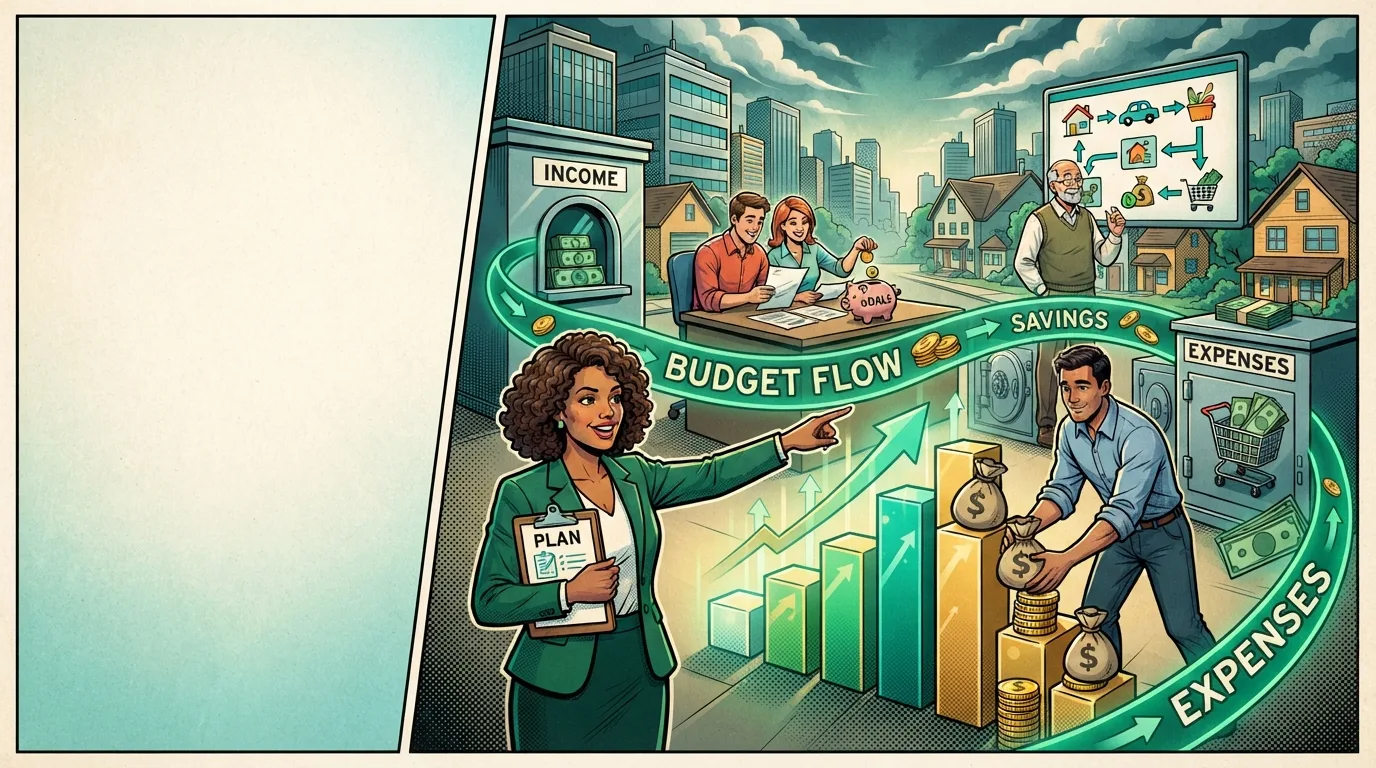
A budget is a plan for where your money goes before it goes anywhere. That definition matters for beginners, because most first attempts fail not from a lack of discipline but from choosing a system that demands more record-keeping than daily life allows. The goal of your first budget is not perfection — it is a repeatable routine you can sustain for years.
The stakes are practical. In the Federal Reserve's 2023 Survey of Household Economics and Decisionmaking, roughly 63% of U.S. adults said they would cover an unexpected $400 expense with cash or its equivalent — meaning a sizable minority could not. A budget that includes a small buffer is what separates a plan on paper from one that survives a car repair. Below are five established methods, how each works, who it suits, and how to run your first month with it.
Start With Your Real Numbers, Not a Template

Every method below assumes you know three things: what you earn, what you must pay, and what you actually spend. Spend two to three weeks gathering that information before you commit to a system.
- Collect statements. Download 60–90 days of checking, credit card, and payment-app history. Annual expenses such as insurance premiums, vehicle registration, and holiday spending are the ones beginners forget.
- Sort into three buckets. *Fixed* costs (rent, loan minimums, insurance), *variable* costs (groceries, fuel, utilities), and *periodic* costs (quarterly or annual bills). Divide periodic totals by 12 to get a monthly figure.
- Use a realistic income number. If your pay varies, use the average of your lowest three months rather than your best month.
- Check your proportions. According to the Bureau of Labor Statistics' Consumer Expenditure Survey, housing accounts for roughly a third of the average household's spending, with transportation and food next. If your own numbers look wildly different, find out why before setting targets.
One rule applies to all beginners: build a small buffer — $500 to $1,000 is a common first milestone — before you optimize anything else. A budget with no cushion breaks on the first surprise.
Method 1: The 50/30/20 Rule
The most widely taught starting point splits take-home pay into three broad groups: 50% for needs, 30% for wants, and 20% for savings and debt repayment above minimums. The framework was popularized by Elizabeth Warren and Amelia Warren Tyagi in their 2005 book *All Your Worth*.
- Needs (50%): rent or mortgage, utilities, groceries, insurance, transportation to work, minimum loan payments, childcare.
- Wants (30%): dining out, streaming services, travel, hobbies, upgraded phone plans.
- Savings and debt (20%): emergency fund, retirement contributions, extra payments on high-interest debt.
On $4,200 of monthly take-home pay, that is $2,100 in needs, $1,260 in wants, and $840 toward savings and debt. The appeal is that it requires only three numbers and no category-level tracking.
The limitation is housing. In expensive metro areas, needs can consume 60–65% of take-home pay, making the standard split impractical. Adjust the ratios rather than abandoning the method — 60/20/20 or 65/20/15 stays true to the structure while reflecting your actual obligations.
Method 2: Zero-Based Budgeting
Zero-based budgeting assigns every dollar of expected income a specific job, so that income minus all allocations equals zero. The zero is not about spending nothing — it is about leaving nothing unassigned, including money directed to savings and sinking funds.
How a month works:
- List expected income for the month.
- Allocate to fixed bills first, then variable categories, then savings goals.
- Create sinking funds for known irregular costs — car maintenance, gifts, annual insurance — funded monthly.
- Adjust as the month unfolds; unspent dollars roll into next month or toward a goal.
Zero-based budgeting is the strongest choice if your margins are thin, your income varies, or you are aggressively paying down debt, because every decision becomes explicit. The trade-off is time: plan on 30–60 minutes for the first few cycles and 15–20 minutes afterward. Its common failure mode is category sprawl — dozens of line items nobody maintains. Start with 10 to 15 categories and split one only when it consistently overspends.
Method 3: The Envelope System
The envelope system gives each discretionary category a fixed amount of cash in a labeled envelope. When the envelope is empty, spending in that category stops until the next funding period. It works because cash is tangible and the limit is visible.
A digital version achieves much the same effect: separate spending accounts at a bank or credit union, sub-accounts offered by some budgeting apps, or prepaid cards loaded with a set amount per category.
- Best for: people who consistently overspend in a few specific areas — groceries, restaurants, entertainment — and who respond well to hard limits.
- Weak spots: online bill pay, subscriptions, and automatic transfers still run through accounts, so fixed expenses stay outside the envelopes. Carrying larger amounts of cash also carries theft risk, and cash purchases may earn fewer card protections or rewards.
The envelope system is usually a supplement rather than a full budget. Many households use envelopes, or their digital equivalents, for two or three problem categories and handle fixed bills automatically.
Method 4: Pay Yourself First (Reverse Budgeting)
Instead of tracking spending and saving whatever remains, reverse budgeting moves money to savings and investments on payday and treats the remainder as spendable. It relies on automation: a scheduled transfer the day after each paycheck, or a split direct deposit that sends part of your pay straight to a savings account.
The method suits people who dislike record-keeping and those whose spending is generally reasonable but whose savings rate is inconsistent. Its weakness is that it can quietly permit overspending if the remainder is never checked against fixed obligations, so pair it with a quick monthly look at your account balances.
For a target, many financial planners suggest working toward saving 15% of gross income for retirement, but that is a long-term goal rather than a starting requirement. Beginning with 1–3% of take-home pay, automated, is more durable than an ambitious rate you cancel in month two.
Method 5: The 60% Solution
A lesser-known option for steady paychecks divides income into five blocks: 60% for committed expenses and 10% each for retirement, long-term savings, short-term savings, and discretionary spending. It is essentially a stricter, more savings-heavy version of 50/30/20, and it works best for households whose fixed costs are already under control. If committed expenses exceed 60% of income, address housing, transportation, or debt payments first.
Which Method Fits You? A Side-by-Side Comparison
| Method | Best for | Monthly effort | Main risk | |---|---|---|---| | 50/30/20 | Beginners who want a low-maintenance framework | Low (15–30 min) | Unrealistic in high-cost housing markets | | Zero-based | Variable income, tight margins, debt payoff | High (30–60 min at first) | Too many categories to maintain | | Envelope | Repeated overspending in specific categories | Low–moderate | Doesn't cover automatic bill payments | | Pay yourself first | Savers who dislike tracking | Very low | Overspending on the remainder | | 60% solution | Stable income, savings-focused goals | Low | Rigid 60% committed-cost ceiling |
You do not have to choose permanently. A common path is to start with 50/30/20 for three months, then move to zero-based budgeting once you know your real category averages.
Five Mistakes That Derail First-Time Budgeters
- Budgeting every dollar with no buffer. Without a small cushion, one irregular expense looks like failure. Fund a $500–$1,000 starter buffer first.
- Ignoring periodic costs. Insurance premiums, taxes due at filing, and annual subscriptions should be divided by 12 and saved monthly.
- Using too many categories. Ten to fifteen is plenty at the start; granularity is a later refinement.
- Setting aspirational limits. A grocery budget 40% below your actual average will be abandoned. Cut 10–15% and hold it.
- Never reviewing. A budget is a forecast that gets corrected monthly. Schedule a 20-minute review on the same date each month.
How to Run Your First 30 Days
- Days 1–7: Track only. Record every transaction without changing behavior. This gives you a baseline and exposes subscriptions you forgot about.
- Days 8–14: Pick one method, choose 10–15 categories, and set amounts based on your week-one baseline rather than on what you wish you spent.
- Days 15–21: Automate. Schedule transfers for savings and sinking funds on payday, and set reminders for bills due mid-month.
- Days 22–30: Reconcile. Compare plan to actual, move overspending from a category with slack, and adjust next month's numbers. Expect the first month to be inaccurate; that is normal.
Once the routine is stable, work toward an emergency fund covering three to six months of essential expenses, though reaching that level may take a year or more. If minimum debt payments are consuming a large share of your income, a nonprofit credit counseling agency can help you evaluate options before you commit to a plan.
Bottom Line
There is no single best budgeting method — only the one you will still be using in six months. Beginners are usually best served by starting simple: track spending for two to three weeks, adopt the 50/30/20 framework or automate savings with pay-yourself-first, and add zero-based or envelope detail only where spending repeatedly goes off track. Keep the system small, build a $500–$1,000 buffer early, and treat each monthly review as a correction rather than a verdict. Consistency, not precision, is what produces the result.