Personal loans are unsecured installment loans that give you a lump sum of cash and require regular payments over a fixed term. They can be useful for consolidating high-interest debt, covering a home repair, or managing a large planned expense, but they are not free money. Understanding how the loan is priced, approved, repaid, and reported to credit bureaus helps you compare offers and avoid borrowing more than you can comfortably repay.
What a Personal Loan Is and How the Money Moves
Most personal loans are unsecured, meaning the lender does not take a specific asset such as a car or savings account as collateral. Some lenders offer secured personal loans, which are backed by collateral and may carry lower rates but put that asset at risk if you default.
Personal loans are available from banks, credit unions, and online lenders. Loan amounts commonly range from about $1,000 to $100,000, and terms often run from 12 to 84 months. Many personal loans have fixed interest rates, so the monthly payment stays the same. Variable-rate loans exist, but they can make budgeting harder because payments may rise if the benchmark rate increases.
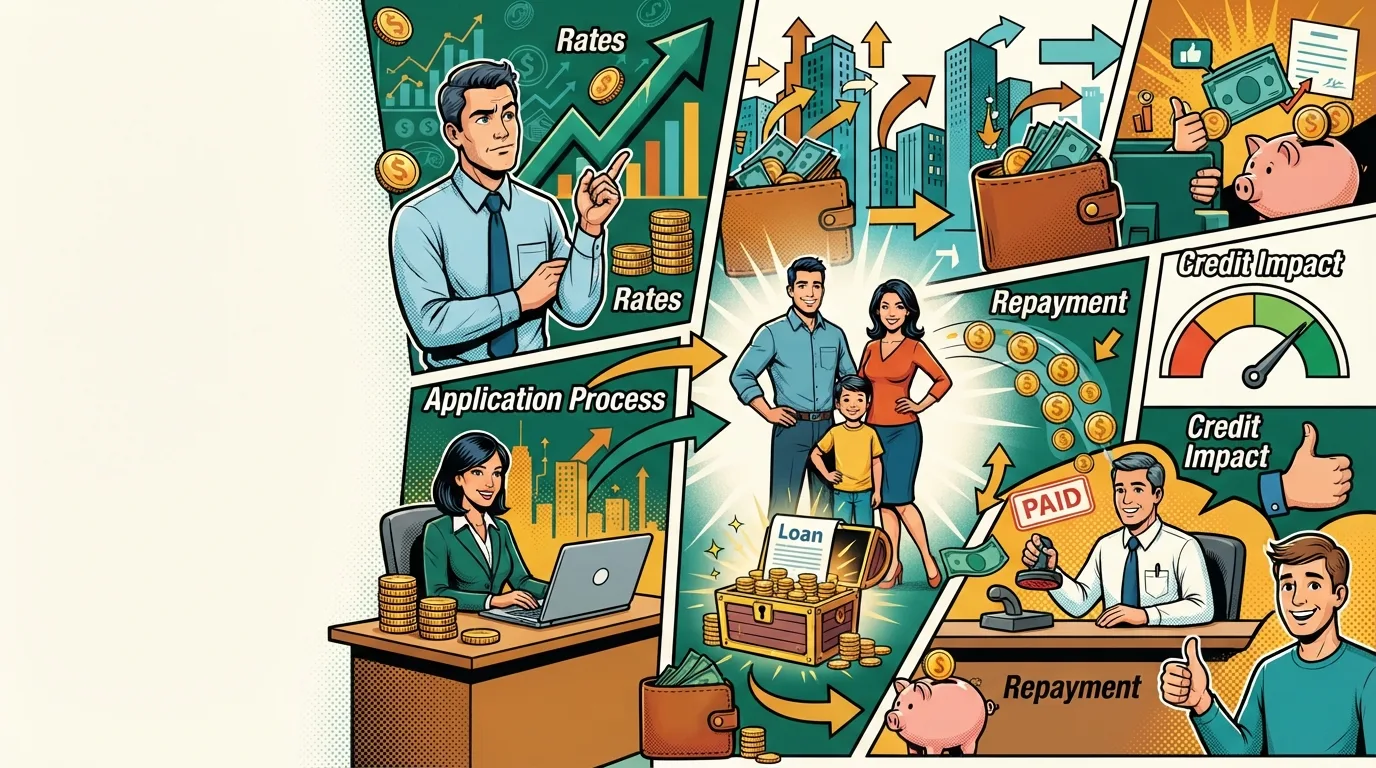
The basic flow works like this:
- You apply with a lender and provide identity, income, housing, and banking information.
- The lender reviews your credit and finances, then decides whether to approve the loan and at what rate.
- If approved, you sign the agreement and receive the funds, usually by direct deposit.
- You repay the loan in equal monthly installments, typically through automatic payments.
- Interest begins accruing according to the loan terms, and the lender reports the account to credit bureaus.
A key number to understand is the annual percentage rate, or APR. The APR includes the interest rate plus certain fees, so it gives a more complete picture of borrowing cost than the interest rate alone. Under the Truth in Lending Act, lenders must disclose the APR, finance charge, amount financed, total of payments, and payment schedule before you sign.
How Lenders Evaluate Your Application
Personal loan approval is not automatic. Lenders assess whether you can repay the loan based on several factors, and their criteria differ. A profile that appeals to one lender may not meet another lender's standards.
Common factors include:
- Credit history and score. Lenders look at payment history, credit utilization, account age, credit mix, and recent inquiries. A higher score often improves pricing, but each lender sets its own cutoffs.
- Income and employment. You generally need to show stable income sufficient to cover the new payment. Lenders may ask for pay stubs, bank statements, or tax documents.
- Debt-to-income ratio. This compares your monthly debt obligations with gross monthly income. Many lenders prefer a ratio below a certain threshold, often in the 36% to 43% range, but requirements vary by product and lender.
- Existing credit accounts. Recent late payments, collections, or high balances can weigh on an application.
- Collateral, for secured loans. If the loan is secured, the lender evaluates the asset's value and may limit the loan amount.
Prequalification is a useful first step. Many lenders let you see estimated rates and terms with a soft credit inquiry, which generally does not affect your credit score. A formal application usually involves a hard inquiry, which can lower a score by a few points. If you are denied, federal law generally requires the lender to provide an adverse action notice explaining the main reasons.
Adding a co-borrower with strong income and credit may improve the terms for which you qualify, but it also makes that person legally responsible for repayment. Approval is conditional and depends on verification; no responsible lender can promise a specific outcome before reviewing your application.
The Real Cost: APR, Fees, and Total Repayment
The monthly payment is only one part of the cost. Two loans with the same payment can have very different total costs if their terms or fees differ.
Suppose you borrow $10,000 for 36 months at a 12% APR. The monthly payment would be roughly $332, and total interest paid over the life would be about $1,957. If the same loan carries a 5% origination fee, the lender may deduct $500 from the proceeds, leaving you with $9,500 while you repay payments based on the $10,000 loan amount. That raises the effective cost of borrowing.
Costs to compare include:
- Interest rate and APR. APR is the better comparison tool because it incorporates certain fees.
- Origination fee. This is often 1% to 8% of the loan amount, depending on the lender and your credit profile.
- Prepayment penalty. Less common on personal loans, but you should confirm that extra payments or early payoff will not trigger a fee.
- Late fees. These vary by lender and state law.
- Other fees. Some lenders charge insufficient-funds fees, check-processing fees, or documentation fees.
Fixed-rate personal loans provide predictable payments, which can make budgeting easier. Variable-rate loans may start lower but can become more expensive if rates rise. Federal Reserve G.19 data tracks personal loan rates at commercial banks, but advertised rates are not a promise; your actual rate depends on your creditworthiness, income, term, and lender.
Before accepting an offer, compare the total of payments, not just the monthly amount. A longer term can lower the monthly payment while substantially increasing the interest you pay over time.
Repayment, Credit Impact, and What Happens If You Miss Payments
Personal loans are amortizing loans. Early payments go mostly toward interest, while later payments go more toward principal. Making extra principal payments can shorten the term and reduce interest, provided the lender applies extra amounts as you intend and does not charge a prepayment penalty.
On-time payments generally help your credit history because payment history is a major scoring factor. A personal loan can also add to your credit mix, which may modestly affect scores. However, taking on a new loan can lower your score temporarily because of the hard inquiry and higher debt balances.
Late payments can be costly. A payment reported 30 or more days late can damage your credit, and continued delinquency can lead to default. If you default, the lender may send the account to collections and, depending on the contract and state law, pursue a lawsuit. A court judgment can lead to wage garnishment or bank account levies in some jurisdictions. Secured loans add another risk: the lender may repossess or seize the collateral.
If you are struggling, contact the lender before you miss a payment. Some lenders offer hardship plans, temporary payment reductions, or due-date changes. Credit counseling agencies can also help you review options. Be cautious with debt consolidation loans: they can simplify multiple payments, but they do not erase debt. Without a spending plan, balances can rebuild.
Common Uses and Alternatives to Compare
People use personal loans for many purposes, including debt consolidation, home improvements, medical bills, moving costs, major purchases, and unexpected expenses. Some lenders restrict certain uses, so review the loan agreement. Using a personal loan for a depreciating purchase or a recurring expense can create a long repayment obligation for something that does not last.
Before choosing a personal loan, compare alternatives:
- 0% APR balance transfer credit card. Useful for credit card debt if you can repay within the promotional period and avoid the post-promotion rate and balance transfer fee.
- Home equity loan or HELOC. These can offer lower rates because they are secured by your home, but your home is at risk if you cannot repay.
- Credit union personal loan. Credit unions sometimes offer competitive rates and lower fees, especially for members.
- Debt management plan. A nonprofit credit counselor may negotiate lower payments or rates on some debts.
- Payment plan with the service provider. For medical bills or home repairs, ask about an interest-free installment plan before borrowing.
High-cost short-term credit can be very expensive and may trap borrowers in repeat borrowing. If you need cash urgently, compare reputable small-dollar loan options from banks, credit unions, and community lenders, and read all disclosures carefully.
How to Compare Personal Loan Offers Step by Step
A disciplined comparison process can save money and reduce stress.
- Check your credit reports. Review reports from the three major bureaus and dispute any material errors before applying.
- Set a realistic budget. Decide how much you can comfortably repay each month after essential expenses and savings.
- Prequalify with several lenders. Use soft-inquiry prequalification where available to see estimated rates without affecting your score.
- Compare APRs, not just interest rates. Include origination fees and any other charges.
- Compare total repayment cost. Multiply the monthly payment by the number of payments, then compare that total across offers.
- Check fees and penalties. Look for origination, late, prepayment, and insufficient-funds fees.
- Read the disclosures and contract. Confirm the payment date, autopay rules, hardship policy, and whether the loan is secured.
- Submit a formal application only when ready. Complete verification promptly and set up automatic payments to avoid missed due dates.
Borrowing can be a reasonable financial tool when the loan is affordable, the purpose is clear, and the terms are understood. It becomes risky when the payment competes with essential expenses or when the loan is used to cover a persistent budget shortfall.
Bottom Line
Personal loans work by providing a lump sum that you repay with interest and fees over a set term. Lenders evaluate credit, income, debt-to-income ratio, and other factors, and approval is never automatic. The APR and total repayment cost matter more than the monthly payment alone. Before borrowing, compare multiple offers, check the fees, understand the credit impact, and confirm that the payment fits comfortably in your budget. Used carefully, a personal loan can consolidate debt or fund a planned expense; used without a repayment plan, it can add financial strain.