Two people owe the same $12,000 across the same three credit cards and have the same $600 a month to put toward debt. One finishes their balances in 26 months and pays less interest. The other finishes in 29 months but never once misses a payment, because the method they chose gave them a visible win at month three. Neither is wrong — which is exactly why the debt snowball vs avalanche debate is less about arithmetic than about which plan you will actually stick with.
Both methods share the same core mechanic: pay the minimum on every debt, then direct every spare dollar at one target debt while the others stay current. When the target is gone, roll its payment into the next one. The only difference is how you order the list — and that single decision changes both your total interest cost and your odds of staying motivated.
How the Debt Snowball Method Works
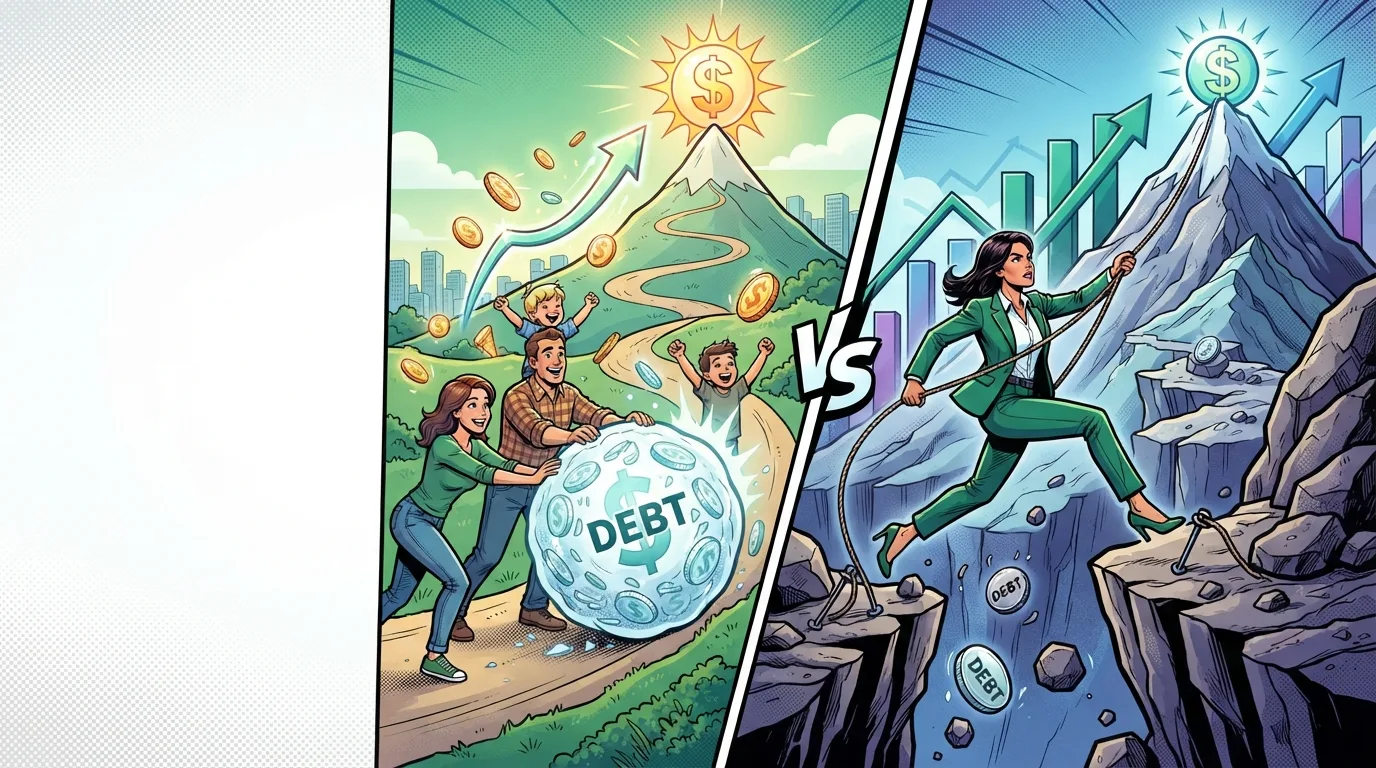
The debt snowball orders your debts from smallest balance to largest, regardless of interest rate.
- List every debt — credit cards, personal loans, medical bills, auto loans — with its balance, minimum payment, and APR.
- Pay the minimum on everything.
- Send all extra money to the smallest balance.
- When that balance hits zero, add its former payment to the next-smallest debt's payment.
- Repeat until all balances are cleared.
Your payment stays roughly the same each month, but it "snowballs" as each cleared payment stacks onto the next target.
Strengths
- The first win usually arrives quickly, sometimes in a few weeks for a small balance.
- Fewer open balances means fewer due dates to track and less room for a late payment.
- Behavioral research on debt repayment has found that consumers derive real motivation from eliminating individual accounts outright, not just from reducing a total.
Weaknesses
- It ignores interest rates, so a 27% store card might sit untouched for a year while you clear a 4% auto loan.
- Total interest paid is usually higher than with the avalanche.
How the Debt Avalanche Method Works
The debt avalanche orders your debts from highest interest rate to lowest, regardless of balance. The mechanics are identical — minimums everywhere, surplus to one target, roll the payment forward — but the target is chosen for cost efficiency.
Strengths
- It minimizes total interest paid and, in most scenarios, shortens the payoff timeline.
- It attacks the debt that is actively growing fastest, which matters most when one APR is dramatically higher than the rest.
Weaknesses
- If your highest-rate debt is also your largest, your first "win" may be a year or more away.
- Progress can feel invisible early on, which is exactly when people quit.
Side-by-Side Comparison
| Factor | Debt Snowball | Debt Avalanche | |---|---|---| | Ordering rule | Smallest balance first | Highest APR first | | Total interest | Usually higher | Usually lower | | Payoff timeline | Usually slightly longer | Usually slightly shorter | | First payoff milestone | Fast | Often slow | | Motivation profile | Quick wins, visible progress | Long-term optimization | | Best fit for | People who have stalled before | People motivated by total cost | | Main risk | Paying extra interest | Abandoning the plan early |
The Math: Why Avalanche Usually Costs Less
Interest is charged on the balance you carry, at the rate you agreed to. That makes the cost of delay easy to see. A $3,000 balance at 24% APR accrues roughly $60 in interest in a single month. The same $3,000 at 9% accrues about $22.50. Every month you keep the high-rate balance alive, you are paying that difference instead of reducing principal.
As a practical illustration, consider two debts:
- Debt A: $3,000 at 24% APR, minimum $75
- Debt B: $2,000 at 0% promotional APR that expires in 14 months, minimum $40
A pure snowball sends your surplus to Debt B first because it is smaller. A hybrid approach would send the surplus to Debt A while paying the minimum on B — then pivot to B before the promo rate resets to a much higher standard APR. The second plan usually costs less and avoids a nasty rate cliff.
Two caveats keep this honest:
- The gap can be small. If all your debts sit within a few percentage points of each other, avalanche may save only a modest amount — often less than the value of staying motivated.
- The gap widens with the spread. When one debt is 25% and another is 6%, ordering matters a great deal. When they are 19% and 17%, it barely does.
According to Federal Reserve data, the average interest rate on credit card accounts has hovered above 20% in recent years, so for most card-heavy households the rate spread is meaningful, not trivial.
The Psychology: Why Snowball Often Wins in Practice
A mathematically optimal plan you abandon in month four is worse than a slightly suboptimal plan you finish. This is the strongest argument for the snowball, and it is an argument about behavior, not arithmetic.
What tends to derail debt payoff:
- Decision fatigue. A plan that requires re-optimizing every month gets skipped.
- Invisible progress. Watching a $9,000 balance drop to $8,400 feels like nothing; closing an account feels like a win.
- Bill overload. Every additional open balance is another due date and another chance to slip.
The snowball manufactures those wins deliberately. If you have started and stopped payoff plans before, that manufactured momentum may be worth more than the interest you save.
One important balance: don't let "quick wins" justify ignoring a genuinely dangerous rate. A 29% APR balance is compounding against you every day, and no motivational benefit reliably offsets a year of that.
A Hybrid Approach That Works for Most People
You are not required to pick a pure version. A workable rule set:
- Check the spread first. If your highest APR exceeds your lowest by roughly 8–10 percentage points or more, lean avalanche.
- Look for a fast first win. If the highest-rate debt is also small enough to clear in two or three months, you get both benefits and the debate is moot.
- Respect promo expirations. A 0% balance transfer that reverts to a standard rate is a scheduling problem; pay it off before the deadline even if it is not the smallest balance.
- Keep a visible scoreboard. Track both total balance and accounts closed. Avalanche users need the second number to stay engaged.
- Re-run the order after each payoff. Rates, balances, and promos change; your plan should follow.
What Both Methods Require to Work
Neither strategy generates money. Both depend on the same foundation:
- A real monthly surplus. Extra payments come from a budget gap, not from willpower alone.
- No new charges. Adding to balances while paying them down is a treadmill with fees.
- A small cash buffer. Even $500–$1,000 set aside reduces the chance that an emergency goes back on a card. Many people pause aggressive payoff for a month or two to build it.
- On-time payments on everything. Payment history is the single largest factor in FICO scoring models at roughly 35%, so a late payment to chase a payoff goal is a bad trade.
- Keeping accounts open. Closing a paid-off card can lower your available credit and raise utilization, which can hurt scores. In most cases, leave it open with a small recurring charge you pay in full.
- Automation. Scheduled payments remove the month-to-month decision entirely.
Common Mistakes to Avoid
- Splitting extra money across several debts. You lose the compounding effect of the rollover.
- Draining retirement accounts. Early withdrawals can trigger income tax plus a 10% penalty in many cases, and borrowed money is rarely repaid on schedule.
- Ignoring a rate reset. A promotional APR expiring mid-plan can erase months of progress.
- Paying for-profit "debt relief" upfront. Under the FTC's Telemarketing Sales Rule, for-profit debt relief companies generally cannot charge fees before they settle or reduce a debt. Legitimate nonprofit credit counseling, by contrast, is typically low-cost and offers debt management plans that may reduce interest rates — though approval and terms depend on your creditors and are never assured.
- Never checking the payoff date. Recalculate it quarterly; a slipping date is an early warning sign.
Bottom Line
The avalanche is the cheaper method on paper, and the snowball is often the more durable method in real life. If your rates are widely spread or your balances are large, order by APR. If your history is a string of abandoned plans, order by balance and let the early wins carry you. Then apply the same discipline either way: pay every minimum on time, stop adding new debt, keep a small cash cushion, and revisit the plan after each account closes. The best payoff strategy is the one you are still following twelve months from now.