A high-yield savings account is a deposit account that generally pays a higher annual percentage yield than a traditional savings account at a large branch-based bank. It is still a savings account: you can add and withdraw money, it is typically insured by the FDIC or NCUA within applicable limits, and it is designed for short-term goals and emergency cash rather than long-term investing. The main difference is the rate—and the trade-offs that often come with it, such as online-only service, variable rates, and transfer timing. This guide explains how high-yield savings accounts work, how their rates are set, how they compare with alternatives, and what to check before opening one.
What Is a High-Yield Savings Account?
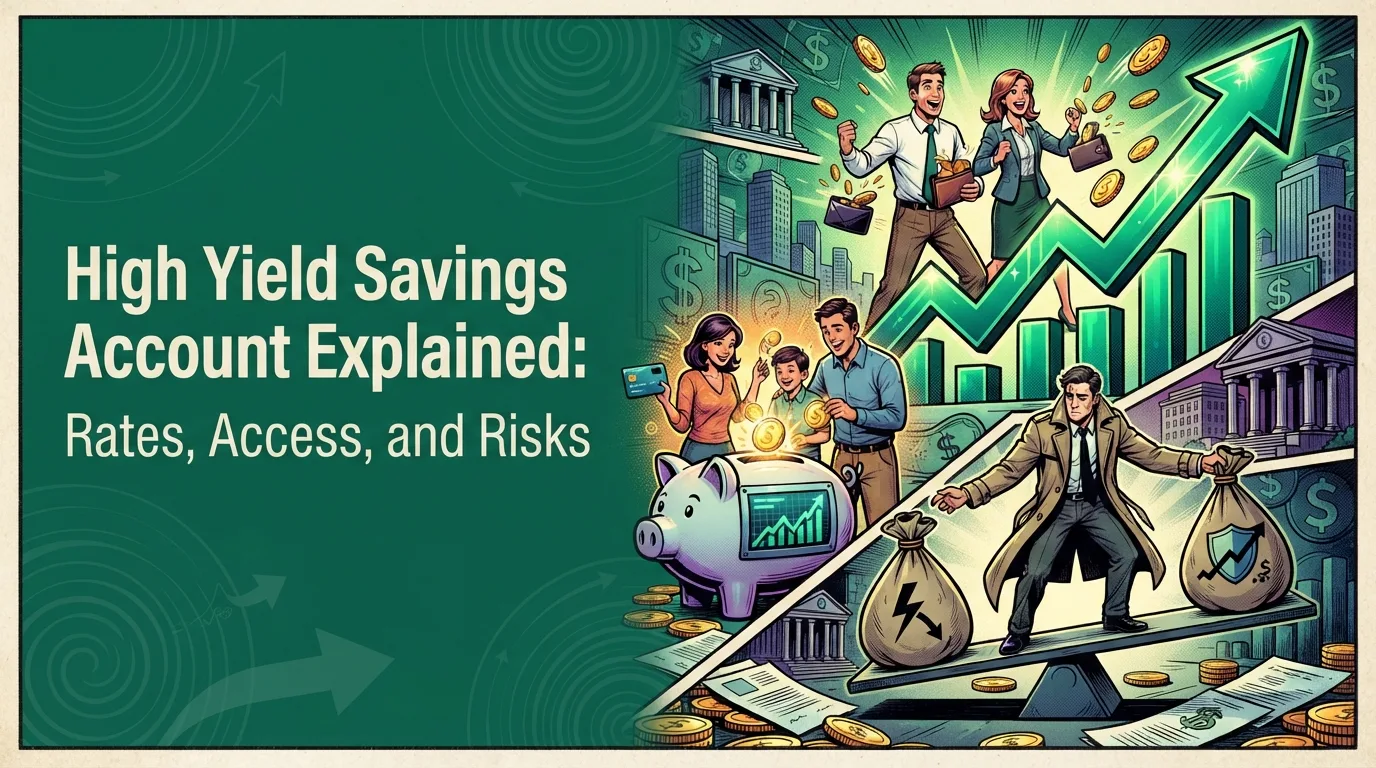
A high-yield savings account—sometimes called a high-interest savings account—is a federally insured deposit account offered by banks and credit unions. High yield is relative, not a formal regulatory category. An account may be called high-yield because it pays more than the national average for savings accounts, often because the institution operates mostly online and has lower overhead than a branch network. As of 2025, many online accounts advertised APYs above 4%, while FDIC national averages for savings accounts were often below 1%. Rates change, so treat those figures as a comparison point, not a permanent rule.
Key features usually include:
- Variable APY. The annual percentage yield can change at any time, usually when the bank adjusts its rate schedule.
- Deposit insurance. Banks are typically insured by the FDIC; credit unions by the NCUA. Coverage applies up to applicable limits and ownership categories.
- Limited transaction design. Savings accounts are meant for saving, not daily spending. Some banks limit certain withdrawals or charge fees after a set number of transfers.
- Online access. Many high-yield accounts are managed through an app or website, with transfers to a linked checking account.
APY is not the same as APR. APY reflects the total interest earned in a year, including compounding, assuming the rate stays the same. APR is generally used for borrowing costs. A savings account's advertised APY is useful for comparison, but it is not a promise that the rate will remain at that level. Also check whether the advertised rate applies to your entire balance or only a portion of it.
How High-Yield Savings Account Rates Work
High-yield savings rates are set by each institution. They are influenced by:
- The federal funds rate and broader interest rates. When short-term rates rise, deposit rates often—but not always—rise too. When they fall, savings rates may follow.
- Competition for deposits. Online banks may raise rates to attract cash.
- The bank's funding needs and business model. A bank may advertise a strong rate to bring in deposits, then adjust it later.
- Account terms. Some accounts pay a lower base rate and a higher rate only if you meet balance, activity, or direct-deposit requirements.
Because APY is variable, a headline rate is a snapshot. A useful example: $10,000 at a 4.00% APY would earn about $400 in a year if the rate stayed unchanged and interest compounded as advertised. If the rate falls to 2.00% after six months, the actual earnings would be lower. The math is straightforward, but the outcome is not locked in.
Compounding matters, though less than the rate itself. APY already incorporates compounding for a 12-month period, so comparing APYs is generally more useful than comparing nominal interest rates. Daily or monthly compounding can make a small difference, but fees and minimum-balance rules can erase it.
Watch for tiered and promotional rates. An account may advertise a high APY but pay it only on the first $5,000, or require a minimum balance, direct deposit, or a certain number of debit transactions. A promotional rate may last only a few months. Read the rate sheet and deposit agreement to see what happens after the promotion ends.
High-Yield Savings vs. Traditional Savings, CDs, and Money Market Accounts
A high-yield savings account is one option in a broader cash-management toolkit. The right choice depends on when you need the money and how much rate certainty you want.
| Account type | Typical rate | Access to cash | Rate certainty | Best for | |---|---|---|---|---| | High-yield savings | Higher than many branch savings accounts | Usually good; transfers may take 1–3 business days | Variable | Emergency funds and short-term goals | | Traditional savings | Often lower | Good | Variable | People who value branch access | | Certificate of deposit (CD) | Often competitive | Limited before maturity; early-withdrawal penalty may apply | Fixed for the term | Money you will not need for a set period | | Money market account | Variable; sometimes competitive | Checks or debit access may be available | Variable | Savers who want some transaction flexibility |
CDs can offer rate certainty, but they trade liquidity for it. If you may need the money unexpectedly, a savings account is usually more flexible. A CD ladder—splitting savings among CDs with different maturity dates—can provide periodic access to cash, but it adds complexity and may not beat a savings account after penalties and taxes. Money market accounts can blend savings and checking features, but they may have higher minimums or tiered rates.
U.S. Treasury bills and money market funds are different products with different risk, tax, and liquidity profiles. Treasury bills are backed by the U.S. government and may offer state-tax advantages, but they are not FDIC-insured savings accounts. Money market funds are investments and can lose value; they are not the same as money market deposit accounts. Match the product to the job rather than chasing a single rate.
How to Choose and Use a High-Yield Savings Account
Start with safety and access, not just the highest advertised yield. A practical checklist:
- Confirm deposit insurance. Look for FDIC membership for a bank or NCUA insurance for a credit union. Use the official lookup tools if you are unsure.
- Read the fee schedule. Watch for monthly maintenance fees, excess-withdrawal fees, paper-statement fees, and outgoing wire fees.
- Check minimums. Some accounts require a minimum opening deposit or balance to earn the advertised APY.
- Understand transfer limits and timing. External transfers can take several business days. Keep enough cash in a checking account for near-term bills.
- Review customer service and access. Online-only banks may have limited phone hours. Confirm how you will reach support if a transfer goes wrong.
- Name beneficiaries. Keep account registrations and beneficiary designations current.
- Automate deposits. A recurring transfer from checking can make saving consistent without requiring active decisions.
Opening an account is usually an online process: you provide identity information, agree to terms, and fund the account by transfer or mobile check deposit. Approval and identity verification are conditional and depend on the institution's requirements. Before funding a large balance, consider making a small test transfer to confirm the linked account and timing work as expected.
Use the account for a defined purpose—an emergency fund, a home down payment, or a sinking fund for irregular expenses. A common guideline is to hold three to six months of essential expenses in cash, but the right amount depends on income stability, job prospects, insurance deductibles, and family obligations. Interest is generally taxable, so expect a tax form for interest earned. Compare at least three accounts, look at recent rate history rather than only today's APY, and set a calendar reminder to review the rate and fees every few months.
Risks, Limits, and Common Misunderstandings
High-yield savings accounts are low-risk deposit products, but they are not risk-free in every sense.
- Rate risk. The APY can fall. A rate that looks attractive today may be average in a year.
- Inflation risk. If the account earns less than inflation after tax, purchasing power can decline.
- Institution and service risk. Deposit insurance protects covered deposits if an insured institution fails; it does not promise that a website, transfer, or customer-service experience will be problem-free.
- Insurance limits. FDIC and NCUA coverage has limits and ownership-category rules. The standard FDIC limit is $250,000 per depositor, per insured bank, per ownership category. Large balances may need to be spread across institutions or titled differently.
- Withdrawal policies. Banks may set limits on certain transfers or withdrawals, and those policies can change.
- Scams. Be wary of unsolicited offers, requests for login codes, and websites that imitate a bank. Type the bank's address directly or use its official app.
A high-yield savings account is not an investment account and does not belong in the same category as stocks or bonds. It is a place for money you want to keep stable and accessible. For longer-term goals, other accounts may be more suitable, but they may involve market risk.
One common misunderstanding is that a high APY means the account is automatically the best place for all cash. In practice, an account with a slightly lower rate but reliable transfers, no fees, and responsive support can be the better choice for an emergency fund. Another is that a savings account is too restrictive to be useful. Many banks allow electronic transfers and ATM access, but the details vary. Check the specific account agreement instead of assuming.
Bottom Line
A high-yield savings account can be a useful home for emergency cash and short-term savings because it typically pays more than a traditional savings account while keeping deposits insured within applicable limits. The trade-offs are variable rates, transfer timing, and the need to monitor fees and terms. Compare APYs, but also compare insurance, access, minimums, and service. Treat the advertised rate as a current offer—not a permanent promise—and review your account periodically as rates and your goals change.